Software engineering is undergoing an unprecedented structural paradigm shift. For over four decades, programming language design evolved along predictable, historically established trade-offs: on one end stood compiled systems languages like C and C++, which delivered bare-metal performance at the cost of manual, error-prone memory management; on the other end resided interpreted, bytecode-managed languages with garbage collectors—such as Python, Java, and JavaScript—which traded raw computational efficiency for developer ergonomics and rapid release cadences.
Today, this long-standing equilibrium is being disrupted by two concurrent technological forces: the regulatory mandate for architectural memory safety and the widespread integration of artificial intelligence code synthesis across professional developer workflows. The ascent of Rust across critical kernels and hyperscale backends, the emergence of heterogeneous compute languages like Mojo optimized for machine learning accelerators, and the transformation of IDEs into collaborative AI agent environments define a transformative new chapter for software engineering.
The Regulatory Mandate for Memory Safety and the Rise of Rust
The decisive catalyst accelerating the adoption of languages like Rust across enterprise infrastructure is systems-level cybersecurity. Longitudinal research by tech leaders including Microsoft, Google, and global cybersecurity authorities consistently reveals that roughly seventy percent of all severe Common Vulnerabilities and Exposures (CVEs) stem from memory-safety flaws: buffer overflows, use-after-free bugs, null-pointer dereferences, and concurrent data races.
In mission-critical software where codebase complexity scales continuously, relying on developer manual vigilance alone has proven unsustainable. Rust addresses this vulnerability directly by introducing a compile-time ownership and borrowing model:
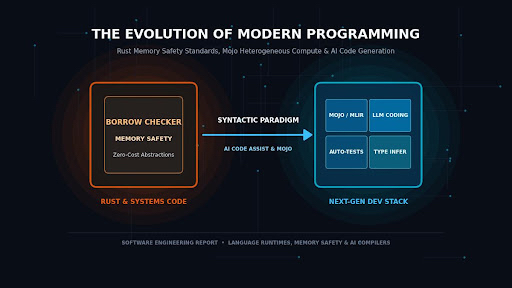
- Compile-Time Invariance: The Rust Borrow Checker validates that every value in system memory has an exclusive owner and that mutable references cannot coexist with shared read references, eliminating data races without runtime garbage collection overhead.
- Zero-Cost Abstractions: Compiling directly to native machine instructions via the LLVM backend, Rust matches C and C++ execution speeds while maintaining an exceptionally small memory footprint and low power envelope.
- Infrastructure Adoption: From native integration within the Linux kernel to core modules in Windows internals and cloud hyperscaler infrastructure, transitioning toward memory-safe systems software has evolved from an engineering preference into an enterprise standard.
| Architectural Vector | Legacy C / C++ | Modern Rust (Systems) | Mojo (AI & Heterogeneous Compute) |
|---|---|---|---|
| Memory Management Paradigm | Manual allocation (malloc/free, raw pointers) | Ownership & Borrowing (compile-time validated) | Flexible Ownership + Python ecosystem parity |
| Runtime Execution Overhead | Zero overhead (deterministic bare-metal) | Zero overhead (no garbage collection latency) | Zero overhead (MLIR / LLVM compiled machine code) |
| Formal Memory Safety Guarantee | None (dependent on manual developer discipline) | Mathematically enforced by compiler borrow checker | Strong static typing and structured memory control |
| Primary Industry Use-Case | Legacy game engines, real-time embedded RTOS | OS kernels, browser engines, cloud infrastructure | AI inference kernels, SIMD acceleration, tensor math |
| Resilience to AI Model Hallucinations | Low (AI easily introduces subtle pointer flaws) | High (Compiler rejects invalid AI-generated borrow code) | High (Rigid type systems constrain generative output) |
The Two-Language Problem: Python Ergonomics and Mojo Performance
While systems programming prioritizes memory safety, scientific computing and machine learning face a distinct challenge: execution throughput. Python is the de facto lingua franca of artificial intelligence due to its accessible syntax and comprehensive open-source library ecosystem (PyTorch, TensorFlow, NumPy). However, the standard CPython runtime faces deep-seated architectural hurdles: the Global Interpreter Lock (GIL), dynamic object allocation overhead, and poor vectorized compute performance.
Historically, the industry navigated these limitations through a fractured two-language approach: expressing high-level algorithmic logic in Python while delegating heavy numerical matrix math to lower-level extensions compiled in C, C++, or NVIDIA CUDA. This architecture introduced significant maintenance overhead, hindered developer debugging, and created packaging hurdles across heterogeneous compute targets (CPUs, GPUs, and NPUs).
Mojo addresses this fragmentation directly by synthesizing Python-compatible syntax with systems-level performance. Leveraging the Multi-Level Intermediate Representation (MLIR) compiler framework, Mojo introduces:
- Progressive Typing and Explicit Ownership: Developers can write high-level dynamic code or enforce strict static typing and manual register control when profiling demands it.
- Native Heterogeneous Hardware Control: Mojo allows developers to program specialized SIMD vector engines and GPU compute shaders natively, eliminating reliance on secondary compiler languages.
- Bare-Metal Performance: Benchmarks across tensor multiplication kernels show execution speeds rivaling optimized C and CUDA code, unifying the software stack from rapid prototyping to production hardware deployment.
The Impact of Large Language Models on the Software Craft
Beyond runtime changes, the nature of how software engineers interact with source code is transforming. Modern generative models and IDE-embedded coding agents have evolved beyond basic line completion: they now refactor distributed services, generate unit and integration test suites, and assist in cross-platform code migrations.
This shift reshapes the core skills demanded of software developers:
- Focus on Architecture Over Syntax: Memorizing specific syntax patterns is increasingly subordinate to designing resilient data models, managing state transitions, and rigorously verifying model-generated logic.
- Strategic Value of Strong Static Typing: Statically typed languages (TypeScript, Rust, Go, Kotlin) provide clear semantic guardrails for AI coding assistants; explicit type systems allow compilers to catch algorithmic hallucinations and logic errors prior to runtime execution.
- Automated Code Maintenance: Upgrading legacy frameworks, generating documentation, and scanning for security regressions are becoming automated pipeline tasks, speeding up continuous integration and delivery (CI/CD) lifecycles.
Software Architecture in the Era of Agentic Workflows
As software development environments shift from passive text editors to proactive agentic environments, the role of code reviews and automated continuous verification expands dramatically. Engineers increasingly spend their cognitive bandwidth evaluating multi-file diffs produced by autonomous coding agents, verifying thread-safety invariants, and inspecting database migration schemas. In this environment, dynamic languages that allow silent runtime type coercion are increasingly viewed as enterprise liabilities, while languages with expressive, rigid type systems and algebraic data types provide the deterministic verification necessary to deploy AI-generated code at scale.
Career Trajectories and the Future Software Workforce
The integration of advanced programming languages and automated development tools elevates engineering rather than replacing it. Technical talent is bifurcating along two primary tracks: systems specialists capable of writing memory-safe, hardware-efficient code for edge and cloud platforms, and distributed systems architects skilled at orchestrating cognitive AI pipelines and ensuring system reliability.
In a rapidly changing development landscape, grounding oneself in core architectural fundamentals—memory models, concurrency primitives, and scalable systems design—remains the most durable defense against technological obsolescence.
Frequently Asked Questions (FAQ)
What defines a memory-safe programming language?
A memory-safe programming language automatically prevents software from reading or writing to unallocated, invalid, or freed memory locations. Examples include Rust, Go, Swift, Java, and C#, in contrast to C and C++ which require manual pointer arithmetic.
Will Rust completely replace C++ in the coming decade?
No. Billions of lines of enterprise C++ power legacy game engines, high-frequency trading platforms, and industrial automation software. However, for greenfield systems programming, cloud infrastructure, and security-critical modules, Rust is increasingly mandated as the primary baseline.
Will AI code-generation models eliminate software engineering roles?
No. AI models act as powerful productivity multipliers for boilerplate code and testing. System architecture design, nuanced security modeling, domain-specific requirements gathering, and final code validation remain indispensable human engineering responsibilities.
Enjoyed This Deep Dive?
Stay ahead of the curve with real-time tech news and analyses. Get the official SviluppoMania app on your device.
 |
|
|