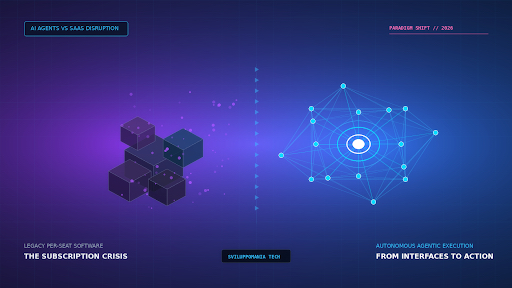
The enterprise software ecosystem is confronting its most profound structural disruption since the advent of enterprise cloud computing. For more than fifteen years, the Software-as-a-Service (SaaS) business model operated as the unquestioned economic engine of the technology sector: centralized multi-tenant cloud platforms, polished graphical dashboards, and monetization built upon recurring seat-based subscription pricing. Across enterprise resource planning, customer relationship management, and productivity suites, software value was directly correlated with human screen time—charging organizations for the privilege of having human operators manually manipulate digital forms.
The rapid ascendancy of autonomous AI agents and Agentic Workflows is dismantling this foundational dynamic. Artificial intelligence is graduating from passive conversational chatbots awaiting direct human prompts into proactive autonomous actors. Modern agentic systems plan multi-step workflows, query production databases, invoke external REST APIs, and execute complex business logic without continuous manual oversight. When an autonomous algorithmic pipeline can independently complete the workload of an entire operational team, the economic justification for seat-based software licensing collapses entirely.
From Passive User Interfaces to Autonomous Execution: Agentic Architectures
To grasp the scale of this technological transition, one must examine the operational mechanics of Agentic Workflows. Unlike traditional single-turn prompt interactions with large language models, autonomous agents execute recursive reasoning, action, and observation cycles (most commonly implemented through the ReAct framework).
The architectural stack of an agentic workflow rests upon four foundational capabilities:
- Goal Decomposition and Multi-Step Planning: Upon ingesting an ambiguous, high-level business objective, the primary orchestrator parses the directive into sequential and parallel sub-tasks, formulating an execution strategy with formal exit criteria.
- Dynamic Tool Invocation and API Grounding: Agents do not merely synthesize descriptive text; they interact with real-world infrastructure by generating SQL queries, calling third-party webhooks, manipulating local file systems, and authenticating with enterprise service endpoints.
- State Memory and Autonomous Self-Correction: When an API request throws an unhandled exception or database results return conflicting attributes, the agent inspects the telemetry, recalculates its intermediate assumptions, and iterates until the target constraint is satisfied.
- Multi-Agent Collaboration and Specialization: Rather than relying on a single monolithic model, enterprise workflows deploy swarms of specialized micro-agents (orchestrators, coders, schema validators, and compliance auditors) that review and critique each other’s outputs, reducing hallucination rates to near-zero tolerance levels.
| Architectural Metric | Legacy SaaS Enterprise Stack | Autonomous Agentic Architecture |
|---|---|---|
| Primary Monetization Basis | Recurring seat-based subscription licenses | Outcome-based pricing or compute/token consumption |
| Human Operator Function | Manual execution (form data entry & clicks) | Strategic policy governor and final validator |
| Primary Interface Tier | Complex graphical dashboards (GUI / Web) | Machine-to-machine communication & headless APIs |
| Operational Execution Velocity | Constrained by human shift hours & latency | Continuous 24/7 autonomous parallel execution |
| Organizational Scaling Elasticity | Linear (requires headcount expansion & seats) | Exponential (instant cloud compute scaling) |
The Collapse of Seat-Based Monetization and the Shift to Outcome Pricing
The most immediate commercial casualty of the agentic revolution is the per-seat software pricing model. When an enterprise employs twenty analysts to reconcile vendor invoices or audit regulatory filings, it purchases twenty individual software licenses. When that workload is ingested by a continuous agentic pipeline running around the clock, human touchpoints contract to a single executive reviewer. This drives an immediate, structural contraction in Annual Recurring Revenue (ARR) for legacy SaaS vendors.
In response to this disruption, enterprise software monetization is undergoing an aggressive realignment:
- Outcome-Based and Value-Driven Pricing: Enterprises are transitioning from paying for software access to paying directly for verified results—such as fixed fees per processed claim, per closed support ticket, or per executed compliance audit.
- Compute and Token Consumption Economics: Billing structures increasingly mirror cloud infrastructure models, invoicing clients based on floating-point compute operations, vector database queries, and inference token volume consumed by the underlying agent pipeline.
- Synthetic Labor Units: Software providers are packaging agents as “digital FTEs” (Full-Time Equivalents), marketing specialized algorithmic labor at a fraction of human overhead with zero operational downtime.
The Disintermediation of Graphical Interfaces: Headless Enterprise Software
The growth of agentic workflows introduces a secondary crisis for traditional application design: the obsolescence of the Graphical User Interface (GUI). For decades, enterprise software providers differentiated themselves through intuitive dashboards, customizable navigation bars, and visual workflows.
In an agent-dominated architecture, software components communicate via high-speed machine-to-machine protocols. Autonomous agents do not navigate HTML canvases, render CSS stylesheets, or click submit buttons; they dispatch structured JSON payloads and consume serialized data streams directly. This transition renders the majority of commercial front-end software obsolete, reducing applications to headless API endpoints and high-performance database layers.
Security, Determinism, and Compliance Challenges
Transferring operational execution from human employees to autonomous algorithmic agents introduces novel threat surfaces and governance hurdles that chief information security officers must navigate:
- Indirect Prompt Injection Vectors: Agents granted access to enterprise inboxes, external web scrapers, or internal documentation repositories can be subverted by malicious payloads embedded in untrusted text, triggering unauthorized data transfers or unauthorized ledger entries.
- Runaway Execution Loops and Compute Cost Spikes: Faulty self-reflection routines or circular logic traps can trigger infinite agent loops, generating tens of thousands of redundant API requests and running up astronomical token bills within hours.
- Immutability and Audit Logging: Regulated industries mandate immutable audit trails. Enterprises adopting agentic pipelines must deploy verifiable ledger technologies to reconstruct the exact chain of thought, tool calls, and data transformations that led to any specific operational decision.
Strategic Outlook: Building the Autonomous Enterprise
The transition from software as a passive tool to software as autonomous labor marks an irreversible threshold in the digital economy. Traditional SaaS providers that fail to unbundle their software architectures into modular, agent-accessible microservices backed by outcome-based revenue models will suffer the same disintermediation experienced by on-premise infrastructure vendors during the early years of the public cloud.
For modern organizations, adopting Agentic Workflows is no longer an incremental productivity experiment; it is the fundamental architectural requirement to achieve operational velocity and scale business outcomes without accumulating corporate friction and ballooning software licensing overhead.
Frequently Asked Questions (FAQ)
What is the fundamental difference between standard generative AI and an Agentic Workflow?
Standard generative AI generates passive text or code in response to a prompt. An Agentic Workflow plans multi-step execution paths, calls external software tools via APIs, reads from and writes to databases, corrects its own errors, and operates autonomously until a designated goal is reached.
Why are autonomous agents disruptive to the traditional SaaS business model?
The legacy SaaS business model relies on selling recurring monthly licenses for each human employee using the software. As autonomous pipelines automate tasks previously performed by humans, the demand for individual user seats contracts, undermining the annual recurring revenue of legacy software providers.
Which enterprise business functions are most immediately affected by this transition?
The most immediately impacted sectors include customer support automation, financial reconciliation, legal and regulatory compliance auditing, IT infrastructure incident response, and B2B sales pipeline qualification.
Enjoyed This Deep Dive?
Stay ahead of the curve with real-time tech news and analyses. Get the official SviluppoMania app on your device.
 |
|
|