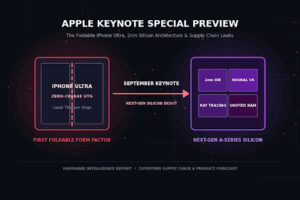
Every autumn, the global tech landscape shifts its focus toward Apple Park. Historically, the September keynote stands as consumer electronics’ most high-profile showcase—a stage primarily dedicated to industrial design refinements, computational photography breakthroughs, and introducing the next generation of mobile devices and wearables. However, analyzing the Apple ecosystem through the spectacle of product keynotes alone risks overlooking the tectonic shifts occurring beneath its software and architectural foundations.
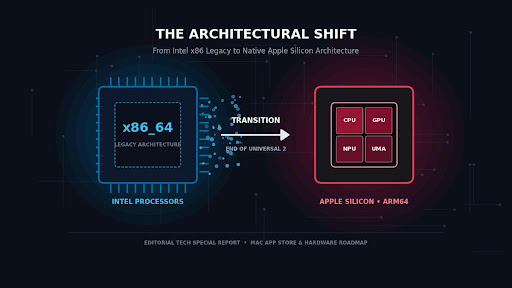
Alongside the commercial fanfare surrounding fresh hardware lineups and on-device machine learning integrations, Cupertino is methodically finalizing its most complex industrial migration in over a decade: the permanent phase-out of the x86 architecture across both its software ecosystem and hardware catalog. Understanding the actual implications of this shift requires examining not merely what is unveiled onstage, but what is systematically being deprecated within development pipelines.
The Mac App Store Shift: Developers Move Away from x86
The definitive turning point for the macOS ecosystem stems from updated developer distribution guidelines. More than four years after initiating the transition to proprietary M-series silicon, Apple now allows developers to submit Mac App Store binaries compiled exclusively for the 64-bit ARM architecture (arm64). Until recently, widespread compatibility required compiling Universal Binaries 2—dual-architecture executables bundling legacy Intel x86 code alongside native Apple Silicon instructions.
While framed as a technical convenience, this policy shift carries substantial operational and commercial consequences. Maintaining dual compilation, continuous testing, and platform-specific debugging strains software teams, particularly independent studios running redundant test hardware. Enabling standalone arm64 deployment triggers an immediate domino effect:
- Reduced package payloads: Stripping redundant legacy x86 binaries slashes application download sizes and storage consumption on Apple Silicon machines.
- Sunset of legacy support: Development teams can deprecate update pipelines and security patches for older Intel workstations to focus engineering resources exclusively on modern macOS APIs.
- Unlocking instruction-set parity: Free from the lowest-common-denominator constraints of x86 compatibility, developers can directly invoke SIMD instructions, unified registers, and integrated neural hardware accelerators.
The Invisible Divide: On-Device AI and Architectural Bottlenecks
Cupertino’s departure from Intel silicon was never solely a supplier negotiation tactic; it was prompted by structural limits inherent in legacy PC designs facing modern algorithmic workloads. Modern on-device generative tasks—encompassing real-time speech processing, localized diffusion tasks, and low-latency text models—rely on tight cohesion between dedicated neural blocks and a Unified Memory Architecture (UMA).
In standard architectures pairing x86 CPUs with discrete graphic accelerators, moving matrices between system memory (RAM) and video memory (VRAM) across the PCIe bus creates substantial bandwidth bottlenecks and latency penalties. Conversely, Apple’s System-on-Chip architecture grants the CPU, GPU, and Neural Engine simultaneous access to a unified memory pool operating with ultra-wide bus widths exceeding hundreds of gigabytes per second.
| Architectural Parameter | Intel-Based Mac (x86_64) | Apple Silicon Mac (arm64) |
|---|---|---|
| Memory Architecture | Discrete RAM and VRAM linked via shared PCIe bus | High-bandwidth Unified Memory Architecture (UMA) |
| Dedicated Neural Processor | None (workloads fall back to CPU or discrete GPU) | Integrated 16-core Neural Engine hardware standard |
| Thermal and Power Envelope | High thermal dissipation requiring aggressive active cooling | High performance-per-watt efficiency with silent operation |
| macOS Roadmap Support | Active deprecation phase (approaching End-of-Life) | Primary baseline architecture for future macOS cycles |
| Local AI Model Capabilities | Restricted or reliant on remote cloud fallback | Native, low-latency on-device hardware inference |
Impact on Enterprise Fleets and End Users
The phasing out of dual-architecture submissions on the Mac App Store presents a clear roadmap deadline for systems engineers and enterprise IT planners. Environments still operating legacy Intel configurations—such as 27-inch 5K iMacs or 2019 Mac Pro enclosures—will face software deprecation sooner rather than later. While base operating system tasks remain functional, access to commercial utility updates, creative software packages, and developer toolchains will rapidly decline over the next twelve to eighteen months.
For secondary consumer markets, this shift accelerates depreciation curves: legacy x86 machines face steep resale drop-offs, relegating them primarily to lightweight web navigation or standalone Linux homelab installations. For enterprise operations, transitioning legacy desktop hardware to M-series silicon is no longer an optional upgrade cycle; it is a prerequisite for security compliance and long-term application compatibility.
Closing a Historic Industrial Chapter
When Steve Jobs announced Apple’s transition from PowerPC to Intel processors in 2005, he framed it as an essential step to free Mac engineering from structural thermal bottlenecks. Two decades later, the cycle has reversed: the legacy x86 instruction set, once the platform’s thermal savior, became the architectural bottleneck holding back low-power computing and localized neural workloads.
The fall keynote represents far more than an iterative refresh of consumer hardware. It serves as the de facto completion of an extensive silicon transition, underscoring Apple’s willingness to abandon legacy backward compatibility in exchange for complete, end-to-end integration across hardware, operating systems, and developer frameworks.
Frequently Asked Questions (FAQ)
Will Intel-based Macs suddenly stop functioning?
No. Existing Intel hardware will continue operating normally for everyday tasks. However, these machines will not support modern on-device AI capabilities and will see third-party App Store maintenance patches phase out over upcoming release cycles.
What was the Universal 2 binary format, and why is it fading?
Universal 2 was introduced in 2020 as a container allowing single executable files to run across both Intel x86 and Apple Silicon hardware natively. With the platform transition mature, developers may now choose to deploy native arm64 binaries exclusively to lower application sizes and streamline deployment pipelines.
Is it worth buying a refurbished or used Intel Mac today?
Unless acquired at nominal salvage prices or required specifically for bare-metal Windows installations via legacy Boot Camp, purchasing Intel hardware is strongly discouraged due to rapid software deprecation and steep secondary market devaluation.
Enjoyed This Deep Dive?
Stay ahead of the curve with real-time tech news and analyses. Get the official SviluppoMania app on your device.
 |
|
|