
The architectural reliability of the modern Windows operating system represents one of the most complex balancing acts in enterprise computing. For decades, Microsoft built its dominant market share on an open, hardware-agnostic platform capable of interfacing with millions of legacy peripherals, specialized expansion cards, and third-party kernel drivers. However, this flexibility came at a steep engineering cost: running untrusted third-party binaries with unrestricted Ring 0 kernel privileges left systems acutely vulnerable to catastrophic failures, unhandled exceptions, and the dreaded Blue Screen of Death (BSOD).
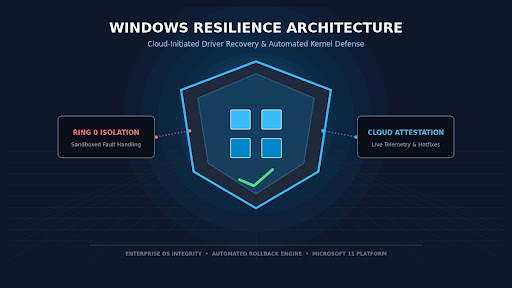
Following widespread outages across global IT infrastructure caused by flawed third-party kernel updates, Redmond has fundamentally overhauled its system reliability philosophy. Rather than relying on reactive troubleshooting and manual offline restoration utilities, Microsoft is deploying Cloud-Initiated Driver Recovery alongside stringent development sandboxing to create an operating system that isolates faults and self-heals before critical boot loops take hold.
Understanding the Ring 0 Dilemma and Third-Party Instability
To understand the scope of Microsoft’s architectural overhaul, one must examine the fundamental design of the Windows NT kernel. The operating system divides execution privileges into distinct hardware-enforced protection rings, primarily Ring 0 (Kernel Mode) and Ring 3 (User Mode). Standard consumer applications, web browsers, and enterprise suites run strictly within Ring 3, where the memory management subsystem enforces process isolation. If an unhandled exception or memory leak crashes an isolated web browser tab, the underlying operating system remains completely unaffected.
In sharp contrast, low-level drivers—including storage controllers, endpoint security agents, network stack modules, and GPU drivers—operate inside Ring 0. At this execution tier, drivers possess raw, unrestricted access to physical system memory and core processor instructions. A single null-pointer dereference, memory overwrite, or race condition executed in kernel space bypasses operating system safeguards, forcing the kernel to trigger an intentional BugCheck halt to protect filesystem integrity. Historically, this design choice preserved data at the expense of uptime, rendering affected machines unreachable without physical IT intervention or manual recovery environments.
| Execution Domain | Privilege Level | Memory Access | Impact of Component Failure |
|---|---|---|---|
| User Mode (Ring 3) | Restricted | Isolated virtual memory space per process | Clean process termination without OS crash |
| Kernel Mode (Ring 0) | Privileged | Direct physical hardware and kernel memory access | Immediate BSOD / BugCheck to prevent corruption |
| UMDF 2 (User-Mode Drivers) | Restricted (Sandboxed) | Controlled IPC via driver host process | Driver restarts transparently in background |
Inside Cloud-Initiated Driver Recovery: The Three-Tier Pipeline
Cloud-Initiated Driver Recovery fundamentally alters how Windows 11 detects, intercepts, and neutralizes faulty driver binaries during early cold boots and low-level initialization sequences. Integrated directly into the Windows Recovery Environment (WinRE) and the early boot loader, the mechanism functions through a synchronized three-tier resilience pipeline:
- 1. Early Telemetry Anomaly Detection: During early boot stages, the Windows boot manager tracks driver initialization sequences against baseline performance signatures stored in Non-Volatile RAM (NVRAM). If a newly installed or updated driver triggers repeated timeouts, illegal memory access, or consecutive BugCheck crashes, the system marks the package as compromised and redirects execution away from the main desktop shell into a secure local recovery sandbox.
- 2. Cloud Attestation and Rollback Verification: Unlike conventional offline recovery solutions that depend entirely on locally stored restore points, the protocol queries Microsoft’s secure attestation endpoints via Windows Update infrastructure. The system checks telemetry feeds to confirm whether the driver issue is widespread. If an emergency vendor hotfix is available, WinRE downloads the cryptographically signed patch; if no fix exists, the system automatically executes a rollback to the last known compliant driver release.
- 3. Hardware-Enforced Fallback State: If internet connectivity is unavailable—or if the local network adapter itself is the faulty driver—the kernel driver loader isolates the offending component. Startup permissions for the specific binary are stripped from the Registry, and generic Windows Class Drivers take over essential display or network functions, allowing the user to reach a stable desktop rather than entering an infinite boot loop.
Tighter Developer Guardrails: The Modernized Windows Driver Kit (WDK)
Automated cloud restoration addresses half the dilemma; preventing unstable code from reaching endpoints in the first place addresses the rest. Microsoft has systematically updated certification standards for original equipment manufacturers (OEMs) and independent software vendors (ISVs) distributing drivers through Windows Update.
The revised compliance standards introduce several mandatory engineering requirements:
- Integration with Modern Compiler Diagnostics: The updated Windows Driver Kit (WDK) requires source analysis using modern Visual Studio compiler diagnostics. Static analysis flags memory-safety violations, uninitialized variables, and stack buffer overruns during the build phase rather than during live runtime.
- Stricter Kernel-Mode Code Signing (KMCS): Microsoft has deprecated legacy cross-signing certificates. All kernel-mode code submitted for distribution must complete rigorous automated test passes within the Windows Hardware Lab Kit (HLK) and earn official WHQL (Windows Hardware Quality Labs) certification.
- Incentivizing the User-Mode Driver Framework (UMDF): Wherever technically feasible, peripheral vendors are pushed to build drivers targeting UMDF 2. By keeping peripheral software in User Mode, device crashes happen in isolation without triggering a kernel halt.
What IT Administrators and System Engineers Need to Know
For corporate IT infrastructure, the shift toward cloud-managed driver recovery transitions support workflows from reactive desk-side remediation to proactive telemetry monitoring. IT administrators managing endpoints through Microsoft Intune or Configuration Manager gain immediate real-time visibility into driver health across hybrid fleets.
Workstations impacted by faulty third-party rollouts no longer require local IT visits with physical boot media and BitLocker recovery keys. Furthermore, security teams can quarantine corrupted endpoint agents remotely without having to manually rebuild machines, saving thousands of operational support hours across distributed enterprise networks.
Conclusion: Towards an Uncrashable Operating System
The evolution of Windows 11 illustrates that resilience in modern computing is not measured solely by avoiding errors, but by how quickly and autonomously an operating system neutralizes them. By pairing early-boot recovery mechanisms with cloud telemetry and restricting unregulated Ring 0 access, Microsoft is addressing the core architectural vulnerability of its operating system.
While backward compatibility remains a foundational pillar of the Windows identity, the era of unmonitored kernel execution is closing. For businesses and everyday users alike, Cloud-Initiated Driver Recovery provides a vital safety net: the assurance that a single rogue driver will no longer cripple productivity or paralyze modern computing infrastructure.
Frequently Asked Questions (FAQ)
What is the primary cause of Windows Blue Screen of Death (BSOD) crashes?
The vast majority of BSOD crashes are caused by third-party drivers running with Ring 0 kernel privileges that trigger unhandled memory exceptions or execution faults, rather than errors within the core Windows operating system itself.
How does Cloud-Initiated Driver Recovery function without an internet connection?
If network connectivity is unavailable, the local boot loader isolates the unstable driver, revokes its auto-start privileges in the Registry, and activates safe Windows Class Drivers to ensure the machine boots successfully into desktop mode.
Will older peripheral hardware continue to work under these new driver rules?
Existing certified drivers will continue to function normally. However, newly released drivers must adhere to modernized WHQL testing and Kernel-Mode Code Signing requirements, while eligible hardware categories are being transitioned toward User Mode (UMDF).
Enjoyed This Deep Dive?
Stay ahead of the curve with real-time tech news and analyses. Get the official SviluppoMania app on your device.
 |
|
|


